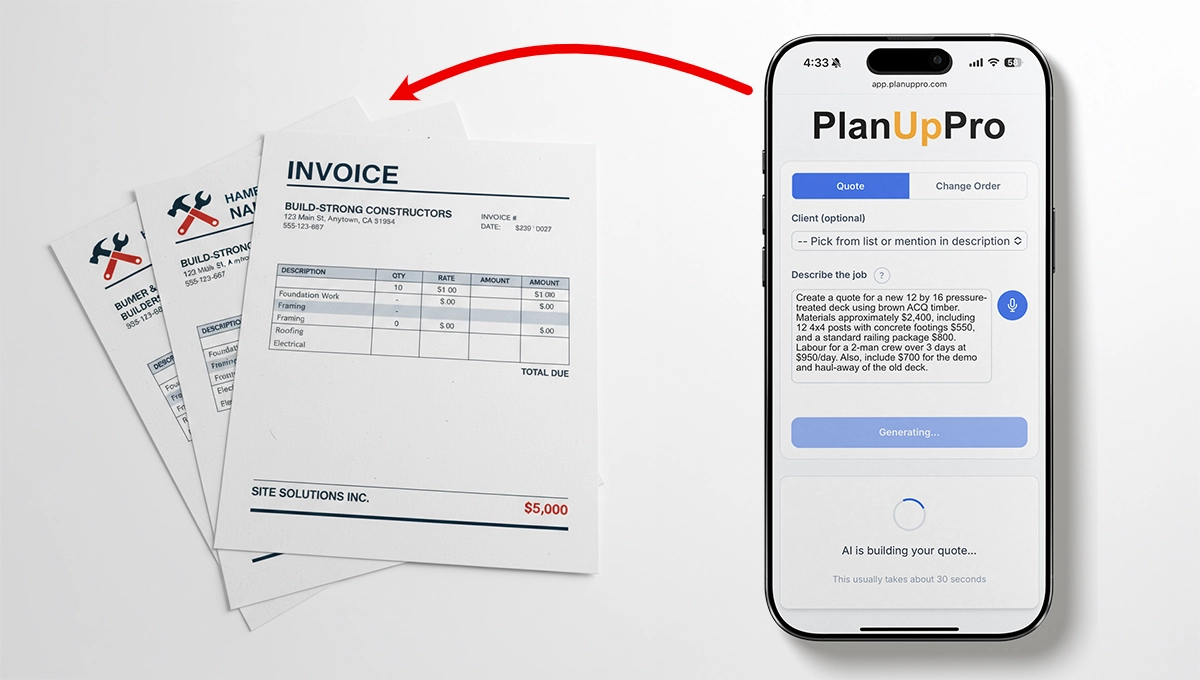
You finished the job. The client is happy. Now comes the part most contractors dread — getting paid.
Here's the reality: slow payments are the #1 cash flow killer in construction. And in most cases, the invoice itself is the problem. It's unclear, it's missing details, or it showed up two weeks late.
A well-written construction invoice does three things: it tells the client exactly what they owe, it removes any reason to delay payment, and it protects you legally if things go sideways. This guide shows you how to write one properly — whether you're a solo handyman or running a crew of 20.
What Is a Construction Invoice?
A construction invoice is a formal payment request sent to a client after work has been completed (or at an agreed milestone). Unlike a quote or estimate, an invoice is not a proposal — it's a bill. It says: this work was done, here's what you owe.
Construction invoices differ from standard business invoices in a few important ways:
- Progress billing — Large projects are invoiced in stages, not all at once
- Retention — Clients often hold back 5–10% until project completion
- Change orders — Additional work gets invoiced separately or as a line item
- Material vs. labor split — Clients and accountants often need these broken out
What to Include in Every Construction Invoice
A professional construction invoice needs specific information. Miss any of these and you're giving the client a reason to "hold off on payment until we sort this out."
| Section | What to Include | Why It Matters |
|---|---|---|
| Your business info | Company name, address, phone, email, license # | Establishes legitimacy and makes you easy to contact |
| Client info | Client name, company (if applicable), project address | Ensures the invoice reaches the right person/department |
| Invoice number | Unique sequential number (e.g., INV-2026-047) | Required for bookkeeping and dispute resolution |
| Invoice date | The date you're sending the invoice | Starts the payment clock |
| Payment due date | Specific date, not just "Net 30" | Removes ambiguity — "Due April 10, 2026" is clearer than "Net 30" |
| Line items | Description, quantity, unit price, total per line | Shows the client exactly what they're paying for |
| Subtotal, tax, total | Subtotal before tax, applicable tax, grand total | Clear math prevents disputes |
| Payment terms | Accepted methods, late fee policy, retention terms | Sets expectations and protects you legally |
| Project reference | Project name, PO number, or contract reference | Helps clients match invoices to budgets (especially GCs) |
How to Structure Your Line Items
This is where most contractors go wrong. Writing "Kitchen renovation — $14,500" on an invoice is asking for trouble. Clients want to see the breakdown. Here's how to do it properly:
Option 1: Labor + Materials Breakdown
Best for residential clients and smaller jobs where the client wants transparency.
| Description | Qty | Unit Price | Total |
|---|---|---|---|
| Demolition labor (kitchen) | 16 hrs | $65/hr | $1,040 |
| Framing and drywall | 24 hrs | $70/hr | $1,680 |
| Cabinets (supplied + installed) | 1 lot | $4,200 | $4,200 |
| Countertop — quartz (supplied + installed) | 38 sq ft | $85/sq ft | $3,230 |
| Plumbing rough-in + fixtures | 1 lot | $2,100 | $2,100 |
| Electrical (sub) | 1 lot | $1,850 | $1,850 |
| Paint + finish work | 12 hrs | $60/hr | $720 |
Subtotal: $14,820 | Tax (8%): $1,185.60 | Total: $16,005.60
Option 2: Phase-Based Billing
Best for commercial projects and general contractors. Group costs by project phase.
| Phase | % Complete | Contract Value | Amount Billed |
|---|---|---|---|
| Site preparation | 100% | $45,000 | $45,000 |
| Foundation | 100% | $82,000 | $82,000 |
| Structural framing | 60% | $120,000 | $72,000 |
| MEP rough-in | 0% | $95,000 | $0 |
This format is common with AIA G702/G703 billing, which many general contractors and project owners require on commercial projects.
Payment Terms That Actually Get You Paid
Your payment terms set the rules. Vague terms lead to vague payments. Here's what works in construction:
Standard Payment Terms
| Term | What It Means | Best For |
|---|---|---|
| Due on receipt | Pay immediately when invoice is received | Small jobs, handyman work, one-day projects |
| Net 15 | Payment due within 15 days | Residential remodels, repeat clients |
| Net 30 | Payment due within 30 days | Commercial work, GC/sub relationships |
| Progress billing | Invoice at agreed milestones (e.g., 30/30/30/10) | Large residential, commercial projects |
| 2/10 Net 30 | 2% discount if paid within 10 days, otherwise due in 30 | Encouraging early payment from commercial clients |
Late Payment Policy
Always include a late fee clause. Industry standard is 1.5% per month on overdue balances. Put it on every invoice, even if you rarely enforce it — it creates urgency.
Example language: "A late fee of 1.5% per month will be applied to balances unpaid after the due date. Work may be suspended on outstanding balances exceeding 15 days past due."
This isn't aggressive — it's standard. And the mention of suspending work is the part that actually motivates payment.
Progress Invoicing: How to Bill Large Projects
On projects lasting more than a few weeks, you should never wait until the end to invoice. Progress invoicing (also called draw requests or applications for payment) keeps your cash flow alive.
How It Works
- Agree on a billing schedule upfront — Monthly, bi-weekly, or at milestones
- Define what triggers each invoice — Percentage of completion, phase completion, or calendar date
- Track completed vs. remaining work — Use a schedule of values showing each scope item
- Apply retention — Typically 5–10% held back until substantial completion
- Send a final invoice — Includes retention release and any remaining balance
Common Progress Billing Schedule
| Milestone | % of Contract | Example ($200K Job) |
|---|---|---|
| Contract signed / mobilization | 10% | $20,000 |
| Foundation complete | 20% | $40,000 |
| Framing / structure complete | 25% | $50,000 |
| MEP rough-in complete | 20% | $40,000 |
| Finishes + punch list | 15% | $30,000 |
| Final completion + retention | 10% | $20,000 |
This approach protects both sides. The client doesn't pay for unfinished work, and you don't finance their project out of pocket.
How to Handle Change Orders on Invoices
Change orders are extra work that wasn't in the original scope. They're also the #1 source of invoice disputes. Here's how to invoice them cleanly:
- Get written approval before starting extra work — A signed change order or even a text message confirmation
- Assign a change order number — CO-001, CO-002, etc.
- Reference it on the invoice — Add a separate line item: "Change Order #CO-001 — Additional bathroom tile work per client request (approved 2/15)"
- Attach the signed change order — Include it as a supporting document
Never bury change order costs inside original line items. When a client sees a number that's higher than the original quote, their first instinct is to question it. A clearly labeled change order removes that friction.
7 Common Invoicing Mistakes That Cost Contractors Money
- Invoicing late — Send the invoice the day work is complete. Every day you wait is a day you're not getting paid. Some contractors wait weeks. Don't be one of them.
- Vague line items — "Labor — $3,200" tells the client nothing. Break it down by task, hours, and rate. Specificity builds trust.
- No invoice number — Without a unique number, clients can "lose" your invoice. It also makes your bookkeeping a mess come tax season.
- Missing the PO number — Commercial clients and GCs often require a purchase order number. Miss it and your invoice goes to the bottom of the pile — or gets returned.
- Not separating materials from labor — Some jurisdictions tax materials but not labor. And clients always want to know where their money went.
- Forgetting retention — If you agreed to 10% retention but invoice the full amount, you'll get a callback and a delayed payment. Calculate it upfront.
- No payment instructions — "Pay me" isn't a payment instruction. Include your bank details, accepted methods (check, ACH, credit card), and where to send payment.
When to Invoice: Timing That Improves Cash Flow
Invoice timing can make or break your project budget. Here are the rules:
- Small jobs (under $5K): Invoice upon completion. Same day if possible.
- Medium jobs ($5K–$50K): Split into 2–3 progress payments. Invoice at each milestone.
- Large projects ($50K+): Monthly progress billing with a schedule of values.
- Service/maintenance work: Invoice weekly or bi-weekly for ongoing work.
The best day to send invoices? Monday or Tuesday morning. Accounts payable departments process payments mid-week. Invoices sent Friday afternoon sit in someone's inbox all weekend.
Digital vs. Paper Invoices
Paper invoices are dying — and for good reason. They get lost, they're slow, and you can't track if the client even opened it.
| Paper Invoice | Digital Invoice | |
|---|---|---|
| Delivery speed | Days (mail) or same day (hand-delivered) | Instant (email/PDF) |
| Tracking | None | Read receipts, payment status |
| Professional look | Depends on your printer | Consistent, branded PDFs |
| Record keeping | File cabinet | Searchable, backed up |
| Payment options | Check or cash | ACH, credit card, online payment links |
| Time to create | 15–30 minutes | Under a minute with the right tool |
If you're still writing invoices by hand or fighting with spreadsheet templates, you're spending time you could be spending on the next job.
Lien Rights and Your Invoice
In most U.S. states (and Canadian provinces), your invoice is connected to your lien rights. If a client refuses to pay, a properly documented invoice history strengthens your mechanic's lien claim. Keep these in mind:
- Send preliminary notices — Required in many states before you can file a lien
- Keep copies of every invoice — Sent date, method, and any client acknowledgment
- Document change orders separately — Disputed extras are harder to recover through liens
- Know your deadlines — Lien filing periods vary by state (30–120 days after last work)
Your invoices aren't just about getting paid today — they're documentation that protects you tomorrow.
Quick Checklist: Before You Hit Send
Run through this before sending every invoice:
- Your company name, address, and license number are on it
- Client name and project address are correct
- Invoice number is unique and sequential
- Date and due date are clearly stated
- Line items are specific — not just "labor" and "materials"
- Subtotal, tax, and total are calculated correctly
- Change orders are listed and referenced separately
- Retention is deducted (if applicable)
- Payment terms and late fee policy are included
- Payment instructions and accepted methods are listed
- PO number or contract reference is included (for commercial work)
If your invoice checks every box on this list, you've eliminated 90% of the reasons clients delay payment.