
You just walked a job site with a homeowner. They liked you. They want a quote by tomorrow. Now you're sitting in your truck wondering — what exactly should I put in this thing?
A good construction quote isn't just a price on a piece of paper. It's the document that either wins you the job or loses it to someone else. And here's the truth most contractors learn the hard way: the quote that looks the most professional usually wins — even if it's not the cheapest.
This guide walks you through exactly what to include, how to format it, and the mistakes that cost contractors real money.
What Is a Construction Quote (And How Is It Different From an Estimate)?
Before we dive in, let's clear up the confusion. These two words get thrown around like they mean the same thing — they don't. For a full breakdown of all four document types, check out our guide on estimate vs quote vs bid vs proposal.
| Estimate | Quote | |
|---|---|---|
| Price | Approximate — can change | Fixed — what you'll charge |
| Commitment | Low — it's a ballpark | High — it's your offer |
| When to use | Early conversations, complex jobs | When you're ready to get the job |
| Legal weight | Not binding | Can be binding once accepted |
Bottom line: An estimate says "it'll probably cost around this much." A quote says "this is my price, take it or leave it." (Need help building accurate estimates? Check out our construction cost estimating guide.)
The 9 Things Every Construction Quote Must Include
Miss any of these and you're either leaving money on the table or opening yourself up to disputes down the road. Here's the complete checklist:
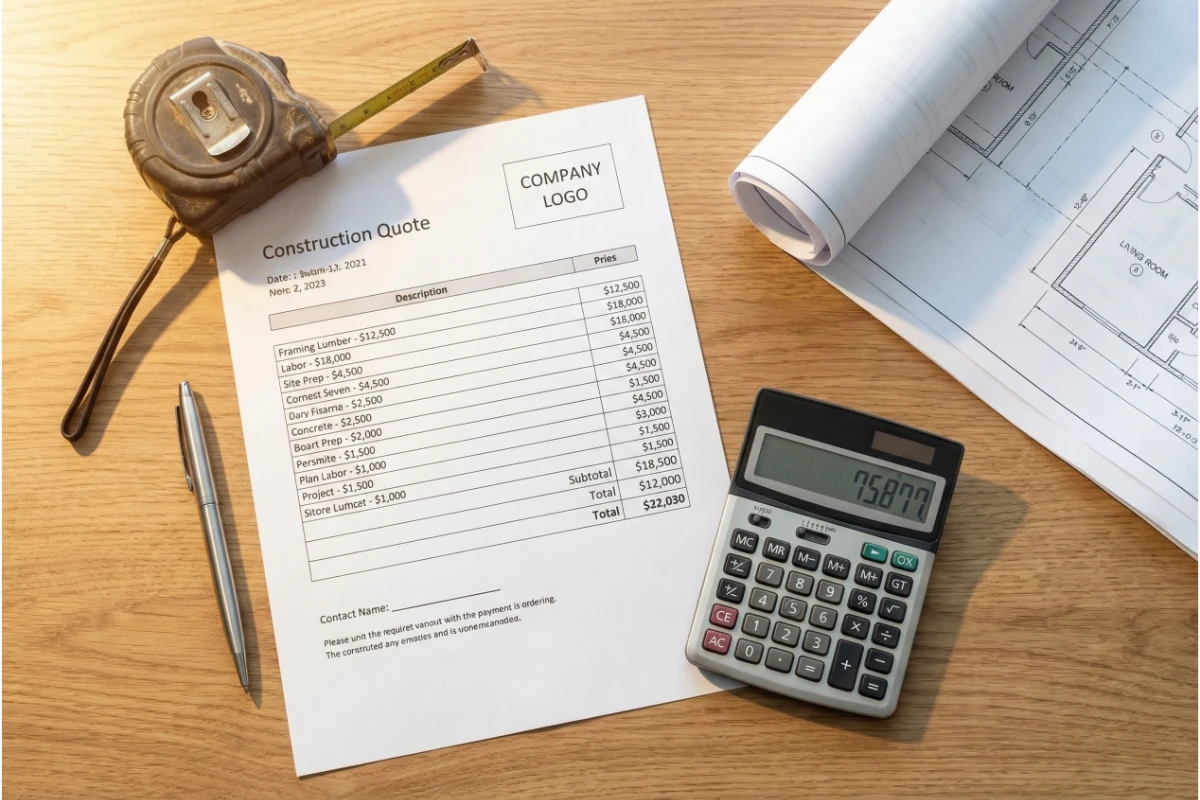
1. Your Company Information
This is your first impression. Include:
- Company name and logo
- Phone number and email
- Business address
- License number (if applicable in your state)
- Insurance information
It sounds basic, but you'd be surprised how many quotes show up without a logo or even a phone number. Homeowners notice this stuff. It screams "I'm not serious."
2. Client Information
Full name, address of the property, phone number, and email. If the client's address is different from the job site address, include both. This avoids confusion later — especially on multi-site projects.
3. Quote Number and Date
Every quote needs a unique number. It doesn't have to be fancy — Q-2026-042 works just fine. This keeps your records clean and makes it easy to reference specific quotes in conversations.
Always add the date. And include an expiration date — usually 30 days. Material prices change fast, and you don't want someone accepting a 6-month-old quote.
4. Scope of Work
This is the most important part of your entire quote. Write down exactly what you're going to do — and just as importantly, what you're not going to do.
Good scope of work:
"Remove existing kitchen cabinets and countertops. Install 14 linear feet of new shaker-style cabinets (client-supplied) and 22 sq ft of quartz countertop including sink cutout. All plumbing reconnections included. Backsplash installation NOT included."
Bad scope of work:
"Kitchen renovation."
The more specific your scope, the fewer arguments you'll have later. Period.
5. Itemized Line Items
Break down the job into individual items so the client can see where their money is going. Here's an example:
| Item | Description | Qty | Unit Price | Total |
|---|---|---|---|---|
| 1 | Demo & disposal — existing cabinets | 1 | $850 | $850 |
| 2 | Cabinet installation (14 LF) | 14 | $120 | $1,680 |
| 3 | Quartz countertop — supply & install | 22 sqft | $85 | $1,870 |
| 4 | Plumbing reconnection | 1 | $450 | $450 |
| 5 | Cleanup & haul-away | 1 | $200 | $200 |
| Subtotal | $5,050 | |||
| Tax (8%) | $404 | |||
| Total | $5,454 | |||
Itemized quotes build trust. When a client can see exactly what they're paying for, they're less likely to negotiate or go with a cheaper (vague) offer.
6. Payment Terms
Be crystal clear about when and how you expect to get paid. Common payment structures:
| Structure | How It Works | Best For |
|---|---|---|
| 50/50 | 50% upfront, 50% on completion | Small jobs under $10K |
| Progress billing | Payments at milestones (30/30/30/10) | Larger projects |
| Net 30 | Full payment due 30 days after completion | Commercial / GC work |
Also state your accepted payment methods (check, bank transfer, credit card) and any late payment penalties.
7. Timeline
Give the client a realistic start date and estimated completion date. If the timeline depends on material lead times or permits, say so. Clients appreciate honesty over optimism.
8. Exclusions
This is your safety net. Clearly list what is NOT included in your quote. Common exclusions:
- Permits and inspection fees
- Structural or hidden damage discovered during work
- Work outside the defined scope
- Furniture moving or appliance installation
- Painting or finishing (if not in scope)
Every exclusion you write down is a potential argument you just avoided.
9. Signature Block
Include spaces for both your signature and the client's. Once both parties sign, the quote becomes a basic contract. Add a line that says something like:
"By signing below, the client agrees to the scope, pricing, and terms outlined in this quote."
5 Mistakes That Make You Look Unprofessional
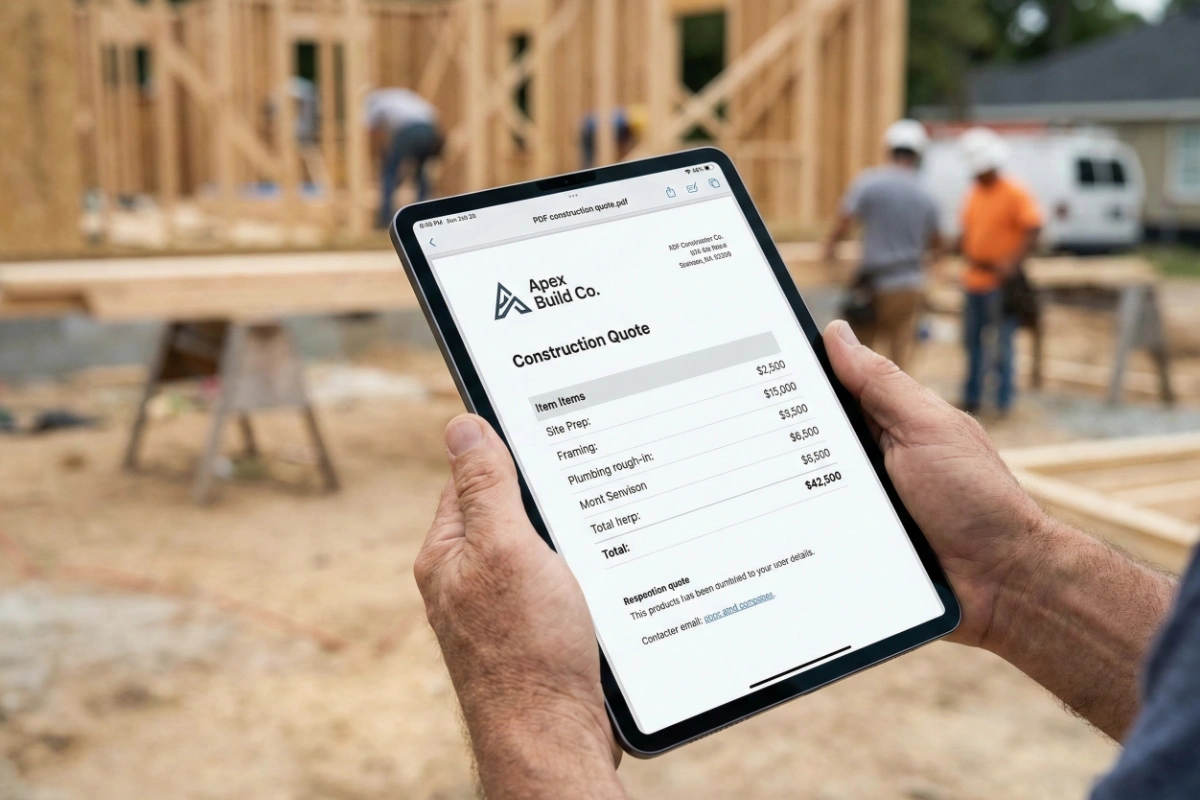
Even experienced contractors make these mistakes. Fix them and you'll immediately stand out:
| Mistake | Why It Hurts You | Fix |
|---|---|---|
| Handwritten quotes | Looks rushed, hard to read, easy to dispute | Use a digital tool or template |
| No logo or branding | You look like a side-hustle, not a business | Add your logo and company colors |
| Vague scope of work | Leads to scope creep and free work | Be specific — describe every task |
| No expiration date | Client accepts 6 months later at old prices | Set a 30-day validity period |
| Sending it late | The first quote in gets the most attention | Send within 24 hours of the site visit |
Real Talk: Speed Matters More Than You Think
Here's a stat that should wake you up: studies show that the contractor who sends the quote first wins the job 60-78% of the time. Not because they're cheaper — because they're faster.
Think about it from the homeowner's perspective. They reached out to 3 contractors. You all walked the site. One of you sends a clean, professional PDF quote that same afternoon. The other two? "I'll get back to you next week."
Who do you think they go with?

The problem is, writing a good quote takes time. You need to calculate materials, labor, overhead, margins — then format everything, add your logo, export a PDF. That's 30-45 minutes for a single quote. By the time you get home, eat dinner, and sit down to write it... the motivation is gone.
That's exactly why tools like PlanUpPro exist. You describe the job in your own words — speak or type — and AI generates a fully itemized, branded PDF quote in about 30 seconds. No spreadsheets, no templates, no laptop required. Just your phone.
Whether you use a tool or do it manually, the rule stays the same: send your quote fast, send it clean, and send it complete.
Free Construction Quote Checklist
Before you send your next quote, run through this list:
| ✓ | Item | Done? |
|---|---|---|
| 1 | Company name, logo, and contact info | ☐ |
| 2 | Client name and job site address | ☐ |
| 3 | Quote number and date | ☐ |
| 4 | Expiration date (30 days) | ☐ |
| 5 | Detailed scope of work | ☐ |
| 6 | Itemized line items with quantities and prices | ☐ |
| 7 | Subtotal, tax, and total | ☐ |
| 8 | Payment terms and methods | ☐ |
| 9 | Timeline (start and end date) | ☐ |
| 10 | Exclusions listed | ☐ |
| 11 | Signature block for both parties | ☐ |
| 12 | Exported as PDF | ☐ |
The Bottom Line
A construction quote is more than a price — it's your pitch, your contract, and your first impression all rolled into one. The contractors who take their quotes seriously win more jobs, have fewer disputes, and get paid faster. If you're preparing quotes as part of a bidding process, our guide to bidding on construction jobs covers the full workflow from finding opportunities to winning contracts.
Take the time to get it right. Or better yet, let AI do the heavy lifting so you can focus on what you do best — building.