
Pricing a construction job wrong is one of the fastest ways to go broke. Price too high and you lose the bid. Price too low and you win the job — but lose money doing it.
The sweet spot is a price that covers your costs, pays you fairly, and still makes sense to the client. Sounds simple. But if you've ever stared at a set of plans wondering "what should I charge for this?" — you know it's not.
This guide breaks down the entire pricing process into clear steps. No MBA required. Just real math and common sense.
The Pricing Formula Every Contractor Should Know
Before we get into the details, here's the big picture. Every construction job price comes down to this formula:
| The Pricing Formula | |
|---|---|
| Job Price = Materials + Labor + Overhead + Profit |
That's it. Four components. Let's break down each one.
Step 1: Calculate Your Material Costs
Materials are the most straightforward part. You need to figure out what you need and how much it costs.
How to do it:
- Do a material takeoff — go through the plans and list every material you'll need (lumber, drywall, fasteners, adhesives, etc.). We cover the full takeoff process in our construction cost estimating guide.
- Get supplier quotes — call your suppliers or check online for current pricing. Don't guess.
- Add waste factor — materials get damaged, cut wrong, or miscounted. Add 5-10% depending on the material.
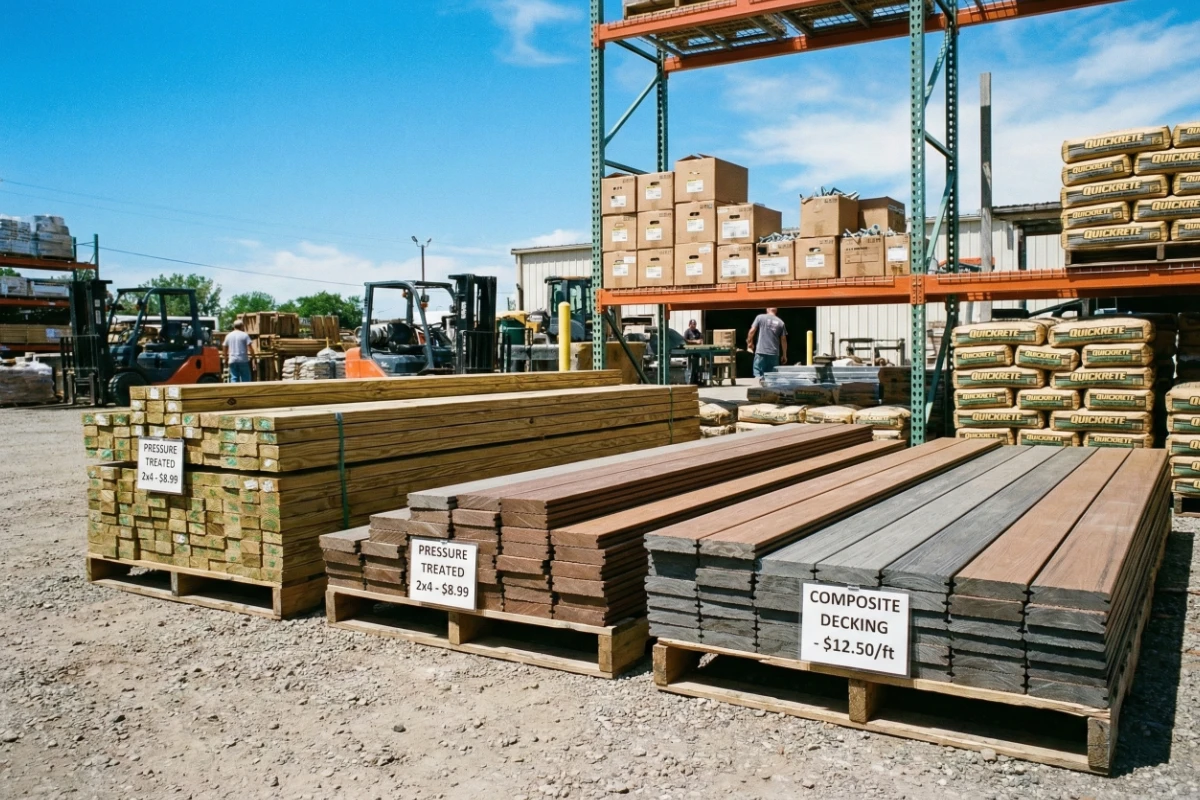
Here's an example for a basic deck build:
| Material | Quantity | Unit Cost | Total |
|---|---|---|---|
| Pressure-treated 2x8 joists (12') | 18 | $14.50 | $261 |
| Composite decking boards (16') | 32 | $42.00 | $1,344 |
| 4x4 posts (8') | 9 | $12.80 | $115 |
| Concrete footings | 9 | $8.50 | $77 |
| Hardware (brackets, screws, bolts) | 1 lot | $185 | $185 |
| Joist hangers | 18 | $3.20 | $58 |
| Subtotal | $2,040 | ||
| + 8% waste factor | $163 | ||
| Total Materials | $2,203 | ||
Pro tip: Material prices change constantly. Never use prices from a quote that's more than 2 weeks old. Lumber alone can swing 15-20% in a single month.
Step 2: Calculate Your Labor Costs
Labor is where most contractors get it wrong. It's not just "what I pay my guys." Your labor cost includes everything it takes to have workers on-site.
What counts as labor cost:
| Cost Type | What It Includes | Example |
|---|---|---|
| Base wages | Hourly or daily rate you pay workers | $35/hr |
| Labor burden | Payroll taxes, workers' comp, benefits | +25-35% of wages |
| Downtime | Paid breaks, weather delays, travel time | ~1 hour/day |
Here's how to calculate the true cost of one worker for one day:
| Component | Calculation | Amount |
|---|---|---|
| Base pay (8 hrs x $35/hr) | 8 x $35 | $280 |
| Labor burden (30%) | $280 x 0.30 | $84 |
| Productive hours (7 of 8) | Adjust for breaks/setup | — |
| True daily labor cost per worker | $364 | |
| True hourly cost (7 productive hrs) | $52/hr | |
Notice the difference? You're paying $35/hour, but the real cost is $52/hour. If you price jobs at $35/hour, you're losing $17 for every hour worked. That adds up fast.
Estimating hours for a job
This is where experience matters. If you've done similar jobs before, you know roughly how long things take. If you haven't, here are a few ways to estimate:
- Use production rates — industry guides publish how long common tasks take (e.g., hanging drywall = ~30 sqft per man-hour)
- Ask your crew — they usually know better than anyone
- Track your time on current jobs — build your own database over time
For our deck example: 2 workers x 4 days = 8 man-days x $364 = $2,912 in labor.
Step 3: Calculate Your Overhead
Overhead is the cost of running your business that doesn't tie directly to one job. It's real money going out the door every month — whether you're working or not.

Common overhead costs:
| Category | Examples | Monthly Estimate |
|---|---|---|
| Vehicle | Truck payment, fuel, maintenance | $800 - $1,500 |
| Insurance | General liability, auto, umbrella | $300 - $800 |
| Tools & equipment | Wear, replacement, rentals | $200 - $500 |
| Office / Admin | Phone, software, accounting | $200 - $400 |
| Marketing | Website, Google ads, signs | $100 - $500 |
| Licenses & fees | Trade license, permits | $50 - $200 |
| Typical monthly overhead | $1,650 - $3,900 | |
How to add overhead to each job:
The simplest method: calculate your annual overhead, divide by the number of jobs you do per year, and add that amount to each job.
For example: if your annual overhead is $36,000 and you do 40 jobs per year, that's $900 per job in overhead.
Or, express it as a percentage of your direct costs (materials + labor). Most contractors use 10-20% as an overhead markup.
Step 4: Add Your Profit Margin
This is the money you actually keep. Not your salary — that's part of labor or overhead. Profit is the reward for taking the risk of running a business.
What profit margin should you use?
| Type of Work | Typical Profit Margin | Notes |
|---|---|---|
| Residential remodeling | 15-25% | Higher risk, smaller jobs |
| New construction | 10-20% | Larger volume, predictable scope |
| Commercial / GC work | 5-12% | Competitive bidding, tight margins |
| Specialty / niche trades | 20-35% | Less competition, specialized skill |
| Service / repair work | 25-50% | Urgency premium, small jobs |
Important: Profit margin is calculated on the total job price, not on your costs. There's a big difference.
If your costs are $6,000 and you want a 20% profit margin, your price is not $7,200. It's $6,000 ÷ 0.80 = $7,500. Here's why:
| Method | Calculation | Job Price | Actual Profit % |
|---|---|---|---|
| Wrong (markup) | $6,000 x 1.20 | $7,200 | 16.7% |
| Right (margin) | $6,000 ÷ 0.80 | $7,500 | 20% |
That $300 difference might seem small on one job. But over 40 jobs a year, it's $12,000 you'd leave on the table.
Step 5: Put It All Together
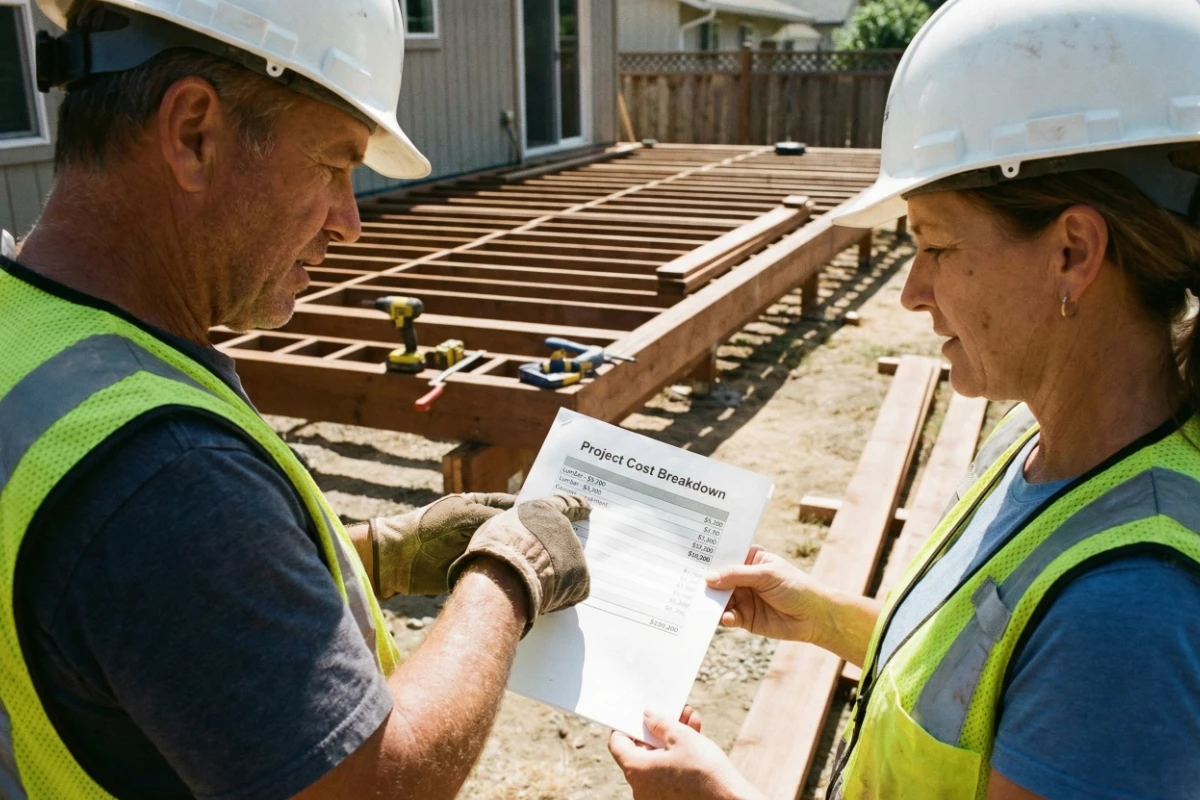
Let's finish our deck example from start to finish:
| Component | Amount |
|---|---|
| Materials (including 8% waste) | $2,203 |
| Labor (2 workers x 4 days) | $2,912 |
| Overhead (15%) | $767 |
| Total costs | $5,882 |
| + 20% profit margin ($5,882 ÷ 0.80) | $7,353 |
| Quote price | $7,350 |
That's a real, defensible number. You can explain every dollar to the client. And you're making a fair profit.
Quick-Reference: Pricing Mistakes That Eat Your Profits
| Mistake | What Happens | How to Avoid It |
|---|---|---|
| Forgetting labor burden | You lose 25-35% on every worker | Always multiply wages x 1.30 |
| Not tracking overhead | Your "profit" is actually covering expenses | Know your monthly overhead number |
| Using old material prices | Your costs are higher than you quoted | Get fresh supplier quotes every time |
| Confusing markup with margin | You make less profit than you think | Use the divide method (cost ÷ 0.80) |
| Pricing based on fear | You charge less because you're scared to lose the bid | Know your numbers — confidence comes from math |
How to Price Jobs Faster (Without Cutting Corners)
Here's the reality: going through this process for every single job takes time. A detailed quote can take 30-60 minutes — and that's after the site visit.
If you're doing 3-5 quotes a week, that's 3-5 hours of unpaid work just on pricing. And the faster you send that quote, the more likely you are to win the job.
This is where technology earns its keep. Tools like PlanUpPro let you describe a job in plain English (or any language) — by voice or text — and the AI generates a fully itemized quote with real material and labor costs for your area. The whole process takes about 30 seconds.
You still review and adjust everything. You're still in control. But instead of starting from a blank spreadsheet, you start with a 90% finished quote that you can fine-tune.
The Bottom Line
Pricing a construction job is not guesswork. It's a system:
- Materials — take off every item, get real prices, add waste
- Labor — use true cost (wages + burden), estimate realistic hours
- Overhead — know your monthly number, spread it across jobs
- Profit — use margin (not markup), and don't apologize for making money
Get these four things right, and you'll price jobs that win work AND make money. That's the whole game. Ready to put your pricing into a professional bid? Our guide to bidding on construction jobs shows you how to find opportunities and submit winning bids.